


LLM Testing Checklist: 50 Validations Before Production
ByPratik Patel
Mar 19, 2026
LLM testing checklist with 50 validations to ensure accuracy, safety, and reliability before deployment. Avoid hallucinations and production risks.

What if the AI that writes your email also fails miserably? Generative AI applications such as ChatGPT excel at having conversations, creating jokes, writing text, and providing programming assistance, but how do we make sure they’re smart, safe, and fair?
McKinsey research estimates the long-term AI opportunity at $4.4 trillion in added productivity growth potential from corporate use cases—but only if these systems perform as intended. So, how do we verify their capabilities?
Testing goes beyond just bug-fixing. It’s about tests of creativity for the AI, a check for facts, and correct responses. Can it handle complex requests? Does that cut down because of harmful or misleading outputs?
It’s like teaching a super-smart (but sometimes clueless) assistant. Here, we will see where we must focus while testing generative AI applications.
Generative AI Testing is the process of systematically evaluating AI systems (like ChatGPT, DALL-E, or Gemini) that create human-like text, images, code, or other outputs. Unlike traditional software testing, it focuses on unpredictable creativity, ethical risks, and real-world reliability—not just bugs.
The complex machine learning models that they use are generally GANs and Transformer models like GPT-4.5 combined to yield results that are often indistinguishable from the stuff of man. However, enormous power comes with great responsibility. These AI models must be produced in a way that is reliable, ethical, and accurate.
Key Applications
Generative AI is widely used in:
Generative AI application tests evaluate performance, accuracy, reliability, and ethics of a generative AI system to ensure high-quality, unbiased, and safe outputs.
Eliminating bias and error in AI systems requires testing generative AI, which Microsoft’s PyRIT research automates the evaluation of AI outputs.
For instance, testing ChatGPT includes:
Currently, generative AI applications are powerful but are not perfect. You all observed the same at the bottom of the ChatGPT interface: there is the text that says, ChatGPT can make mistakes.’ Check important info”.
Understanding generative AI risks, including issues like embedded bias, hallucinations, privacy concerns, and cybersecurity threats, is crucial for ensuring the safe deployment of these applications.
That proves that ChatGPT performance can be nullified if not tested thoroughly. Testing these applications is crucial for several reasons:
Generative AI applications are different when it comes to testing. Generative AI also comes with additional complexity to evaluate in ways traditionally unaddressed by tackling the challenges in the form of red teaming to expose vulnerabilities, benchmarking, and building AI applications that meet a desired quality to get functionality.
In the conventional world of testing, the main focus is typically to demonstrate that the software does meet a particular functionality or performance criteria.
Testing generative AI models comes with its own unique set of challenges. Let’s take a look at the main issues you might face:
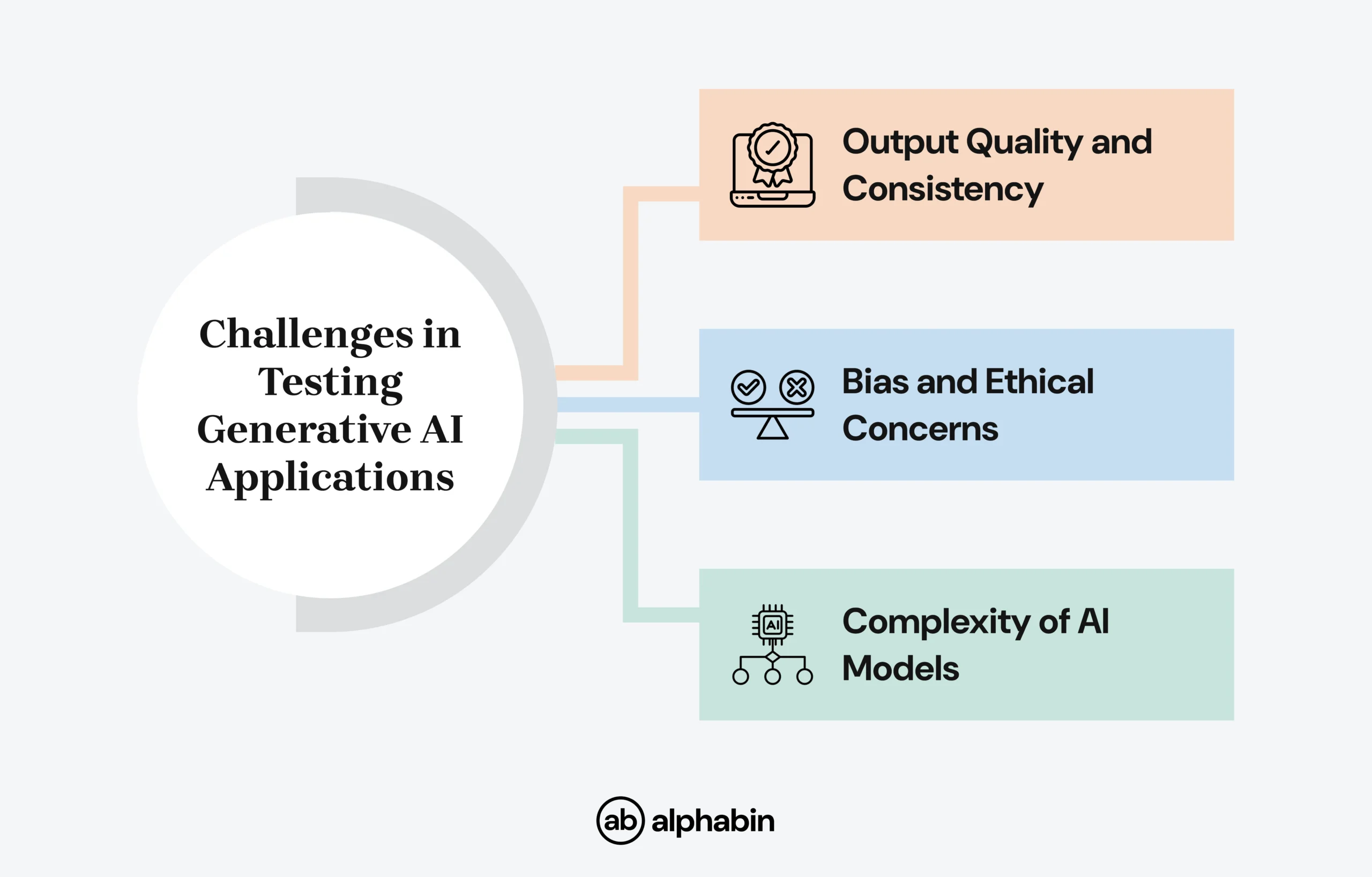
An AI test is needed to ensure that the generative AI application generates good content. The first response could be spot on, and the next completely off the mark.
If there is no consistency in the tool, it can be frustrating and the ai tool can lose its value of use. When testing generative AI applications, it is important to make sure that the model consistently produces reliable and adequate content.
The quality of the data that goes into training an AI model is the only limiting factor. If the training data is tainted, the AI testing tools will likely end up with tainted or harmful content. To ensure that generative AI works morally, testers must test it for biases.
Especially of very complex generative AI models. These huge data are analyzed and the response is generated based on patterns learned during training. For AI testing, their performance will need to be evaluated and their decision-making process will need to be understood.
And now that you have learned the challenges, how about discussing some strategies for testing generative AI apps? These are a few of the ways you can be certain that your Generative AI models operate as expected.

AI-powered testing tools can help eliminate the test loops required for generative AI applications and, as a result, reduce the time and effort spent testing them. These tools let you do those repetitive tests, for example, verifying that the AI models return the expected content from a given input.
Validation of data and performance of the model can be done using tools such as TensorFlow Extended (TFX) or MLflow.
Automated testing is useful, but the human evaluators must be included. Human-in-the-loop (HITL) testing is testing generative AI models by people. Especially for the quality of the content and ethical integrity, this step is very important.
Finally, human testers can evaluate whether (and even how much) the responses from the AI are relevant, accurate, and in line with societal norms and the ethical standards associated with them.
Unlike traditional AI applications, generative AI applications are changing by the minute as they are learning and evolving. Thus, you should have continuous testing and monitoring systems.
You can monitor the AI’s performance with these systems over time and detect any emerging issues. Real-time monitoring will enable problems to be quickly resolved so that generative AI models can keep providing high-quality results.
Working with AI is liable for bias. During AI testing, you should apply certain techniques to mitigate biases in AI models. Fairness constraints can be driven and intended data augmentation can also be done in an attempt to diversify the training data.
Test Generative AI applications like ChatGPT requires a structured approach to ensure accuracy, fairness, and scalability. Below are the key steps to evaluate performance, ethical concerns, and continuous improvements.
Generative AI applications are subject to testing to ensure that they do what they are meant to. Whether it’s bias mitigation, performance testing, or real-world simulations, there are a lot of ways in which you can verify that your AI models are accurate, ethical, and good to use.
A well-thought-out testing approach will result in better quality and more reliable generative AI applications. As with using AI test tools for automation or even manually testing the AI models themselves, thorough testing of the AI will ensure that your tools are ready for the real world.

Founder and CEO
Pratik Patel is the founder and CEO of Alphabin, an AI-powered Software Testing company. He has over 10 years of experience in building automation testing teams and leading complex projects, and has worked with startups and Fortune 500 companies to improve QA processes. At Alphabin, Pratik leads a team that uses AI to revolutionize testing in various industries, including Healthcare, PropTech, E-commerce, Fintech, and Blockchain.
ByPratik Patel
Mar 19, 2026
LLM testing checklist with 50 validations to ensure accuracy, safety, and reliability before deployment. Avoid hallucinations and production risks.

ByPratik Patel
Mar 18, 2026
Build reliable AI features with structured LLM testing. Learn how to prevent hallucinations, measure accuracy, automate evaluations, and scale testing with CI for production-ready AI systems.

ByPratik Patel
Mar 16, 2026
Learn how to test LLM applications effectively. Discover key metrics, evaluation frameworks, and strategies to detect hallucinations, bias, and performance issues.