


LLM Testing Checklist: 50 Validations Before Production
ByPratik Patel
Mar 19, 2026
LLM testing checklist with 50 validations to ensure accuracy, safety, and reliability before deployment. Avoid hallucinations and production risks.

Artificial intelligence (AI) is changing the software development landscape, particularly in the quality assurance (QA) domain. According to a market study, the AI market is projected to reach US$826.7 billion by 2030, driven by a CAGR of 28.46% and widely adopted across industries globally.
Speed in today’s market cannot be overemphasized because the market demands faster and much better quality software. Typically, the approaches to QA are complex and fail to suffice for the goals and timelines of today’s software development life cycle (SDLC).
This is where AI testing tools come into play. Their major benefit is that they improve the testing process, facilitating quicker product launches with greater precision and less reliance on humans. Testing cycles are also best handled by AI-powered solutions, as the solution can automate many tasks as well as offer continuous testing on Android and iOS devices.
As organizations require dependable and quicker QA solutions, AI-based testing tools have emerged as driving forces for embracing quick and efficient testing.
An AI testing tool includes machine learning (ML), natural processing language (NLP), and predictive analysis that helps in improving testing methodologies. This tool simulates a human tester, allowing for faster testing, smart identification, and automation that continues to learn how to avoid false positives over time.
Automation testing tools for AI have greatly enhanced testing services because of efficiency, accuracy, and flexibility as opposed to conventional testing methods. Here are the key reasons why organizations should adopt AI-powered testing tools:
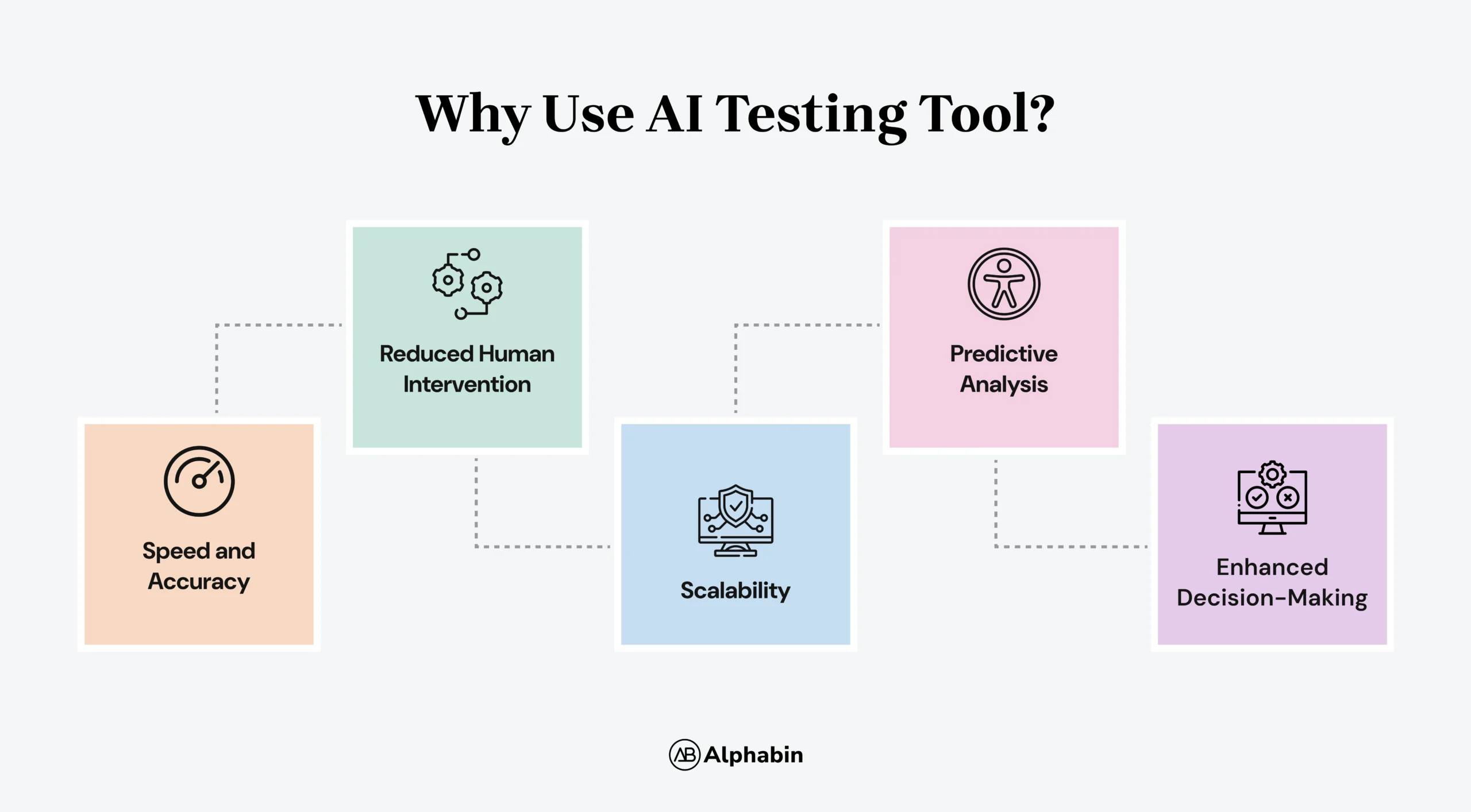
As it is in any sport, the right equipment is crucial for the expert to record enhanced results; the same applies to AI testing tools. Well, now let’s proceed here and see the ten splendid AI testing tools that enhance the test experience!

TestGenX is a new AI-based testing tool developed by Alphabin that aims to transform the process of testing software for teams. However, blending innovation with simplicity, TestGenX unleashes the capability of quality assurance teams to facilitate test generation, implementation, & management effortlessly.
One of the many strengths of TestGenX is that it easily records user actions and automatically creates precise automation scripts in Node.js code without any human intervention. This allows script creation in less than half the time and effort compared to the alternatives.
In addition, TestGenX has the provision for parallel running of test scripts (for large projects/clients), thereby reducing testing cycles while enhancing performance. Beyond automation, TestGenX brings unmatched value through:
Automating tests is not enough. TestGenX makes testing smarter, faster, and more reliable. Regardless of your scale, from startup to enterprise, TestGenX brings you the ability to deliver high-quality software with minimal effort but lots of results.

Rova AI, developed by Scandium Systems, introduces a different approach to AI-powered testing, one that moves beyond assisting testers to actively performing testing as an autonomous agent.
While many AI testing tools focus on accelerating script creation and improving test maintenance, Rova AI is built to reduce the need for scripting altogether. Instead of relying on predefined flows or recorded actions, teams can simply provide a goal and a URL, and Rova AI explores the application, generates test scenarios, executes them, and reports issues independently.
What makes Rova AI particularly effective in modern development environments is its ability to work from context, not just instructions. By integrating with tools like Jira and Linear, teams can tag @rova directly on tickets. Rova AI interprets the requirement, extracts testable objectives, and runs relevant tests automatically, aligning QA efforts closely with real product work.
This shift from scripted automation to autonomous exploration helps teams uncover issues that predefined test cases often miss, especially in complex, rapidly evolving applications.
Rova AI also minimises one of the biggest challenges in QA: maintenance. Rather than requiring constant updates when UI elements or workflows change, it adapts dynamically, continuously improving its understanding of the application and expanding test coverage over time.
Key capabilities include:
Rova AI is best suited for teams looking to go beyond traditional automation and adopt a more scalable, intelligent QA approach, where testing is not just faster, but fundamentally smarter.

TestSigma is one of the AI-based test automation tools available in the cloud for web, mobile & API testing.
Key Features

LambdaTest’s KaneAI provides continuous automation by harnessing the power of AI to write, execute, manage, and debug tests to improve test effectiveness.
Key Features

Katalon is an AI-powered testing tool for web, API, mobile, and desktop apps. The features include automatic healing tests, smart object detection, and script generation to simplify automating, reduce maintenance, and quickly identify problems.
Key Features

BaseRock AI is an agentic QA platform that addresses a gap AI coding assistants have created: code now ships faster than business logic can be validated. A build can pass every test and still silently break a critical customer workflow. BaseRock is built specifically to catch these logic regressions before they reach production, continuously validating customer and revenue outcomes rather than just code correctness.
Key Features

AI-powered test automation tool TestComplete has checkpoints for verifying images, tables, and settings. It allows testers to easily design, maintain, and deliver functional tests for desktop and web applications as well as mobile applications.
Key Features

Functionize is an AI testing tool that is suited for testing such complex applications. Deep learning AI automatically runs tests, builds, and runs tests in CI/CD pipelines and creates functional and end-to-end test coverage.
Key Features

Applitools is an AI visual testing company that enables machine learning-based UI compatibility among devices. This validation type is useful in areas such as e-commerce and financial sectors since it pumps up usability by providing reliable vision validation.
Key Features
ACCELQ is a cloud-based AI-powered test automation platform that provides codeless solutions for enterprise applications. It enables automation for web, mobile, API, and desktop and facilitates reliable, long-term test execution.
Key Features

Mabl is a web application test automation tool built for agile teams. It learns using machine learning but is adjusted to changes, and this way has broad test coverage and is easy to use for all team members.
Key Features
There are some important factors to keep in mind when choosing the best AI testing tool for your organization so that it can be effective, help you be more productive, and provide reference value. Below are detailed criteria to guide your decision:
It should just fit seamlessly with your current CI/CD workflow and work with popular setups like Jenkins or GitHub Actions. Robust custom APIs will help you be flexible and cause minimal disruption to your existing processes.
Also, look for self-healing/automated testing to adapt to the changes in the app, machine learning for smart test prioritization, and predictive analytics for helping proactive issue detection. They help make the system more efficient and more pleasant to maintain.
Make certain that the tool allows testing on the web, mobile, and APIs; further, it should have the ability to simulate the environment by different browsers, devices, and networks. Another requirement is the ability to operate running on either a cloud or on-premise solution.
Select a tool that meets your budget, meaning all costs, such as the license fee and expenses for maintenance. It should be able to accommodate projects of any size and should be able to suit flexible licensing models.
Alphabin’s TestGenX is a revolution in the way testing cycles are managed within the software development life cycle. It enables QA teams to handle the testing process smoothly, automate boring tasks, and work together without any setbacks for both Android and iOS devices.
A great effect of selecting an ideal testing platform for delivering quality software within the shortest time possible. Here’s why TestGenX stands out from the competition:
Teams that adopt TestGenX experience:
By integrating AI in software testing and AI testing tools into the QA, we are rewriting the face of software quality assurance and enabling businesses to satisfy the needs of fast development cycles and produce flawless applications with confidence.
TestGenX by Alphabin stands out among the large options in terms of its capability for test generation, execution speed, and extreme accuracy. TestGenX simplifies QA processes and provides high-quality software efficiently, whether for small-scale or enterprise-level projects.
Alphabin also offers a comprehensive suite of software testing services, such as regression testing, end-to-end testing, and mobile app testing, that are designed to ensure the quality, performance, and security of your applications.

Founder and CEO
Pratik Patel is the founder and CEO of Alphabin, an AI-powered Software Testing company. He has over 10 years of experience in building automation testing teams and leading complex projects, and has worked with startups and Fortune 500 companies to improve QA processes. At Alphabin, Pratik leads a team that uses AI to revolutionize testing in various industries, including Healthcare, PropTech, E-commerce, Fintech, and Blockchain.
ByPratik Patel
Mar 19, 2026
LLM testing checklist with 50 validations to ensure accuracy, safety, and reliability before deployment. Avoid hallucinations and production risks.

ByPratik Patel
Mar 18, 2026
Build reliable AI features with structured LLM testing. Learn how to prevent hallucinations, measure accuracy, automate evaluations, and scale testing with CI for production-ready AI systems.

ByPratik Patel
Mar 16, 2026
Learn how to test LLM applications effectively. Discover key metrics, evaluation frameworks, and strategies to detect hallucinations, bias, and performance issues.